Pinhole News

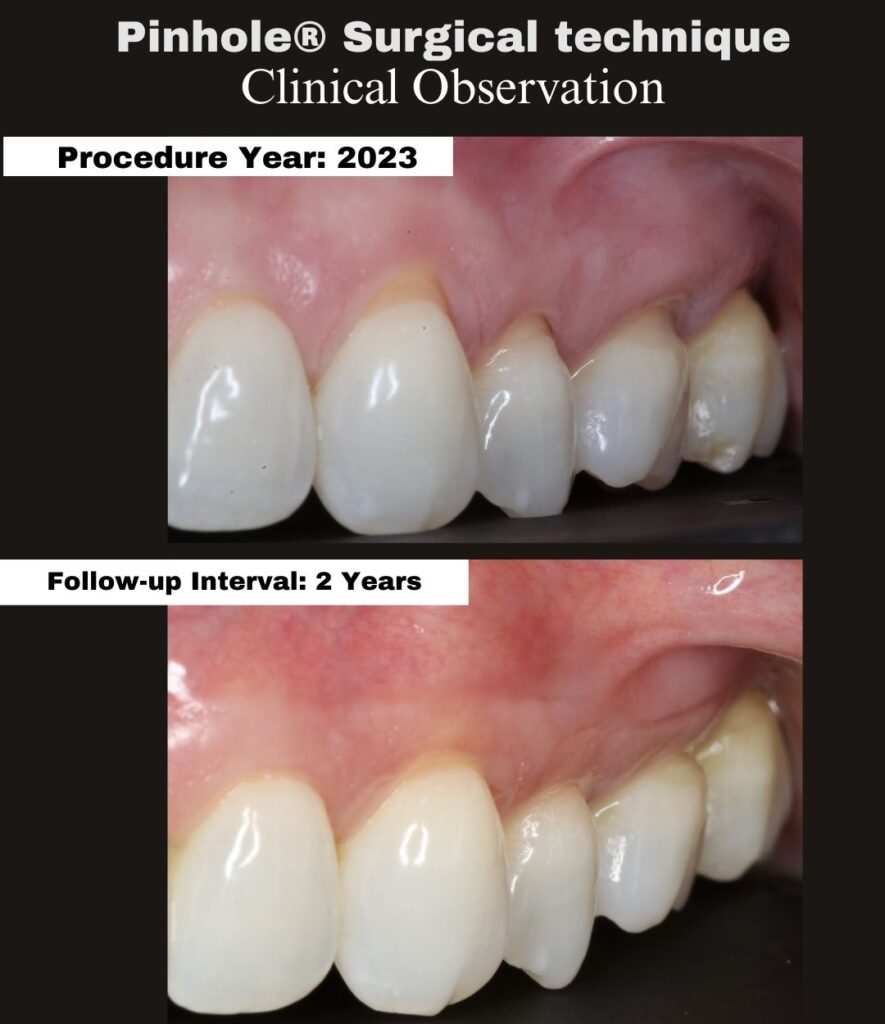
Clinical Observation — Gingival Recession

Case Identification
Procedure: Pinhole® Surgical Technique
Tooth/Teeth: #18–22, #24–31
Procedure date: 05/23
Post-operative interval: 2.5 Years
Post-operative date: 01/26

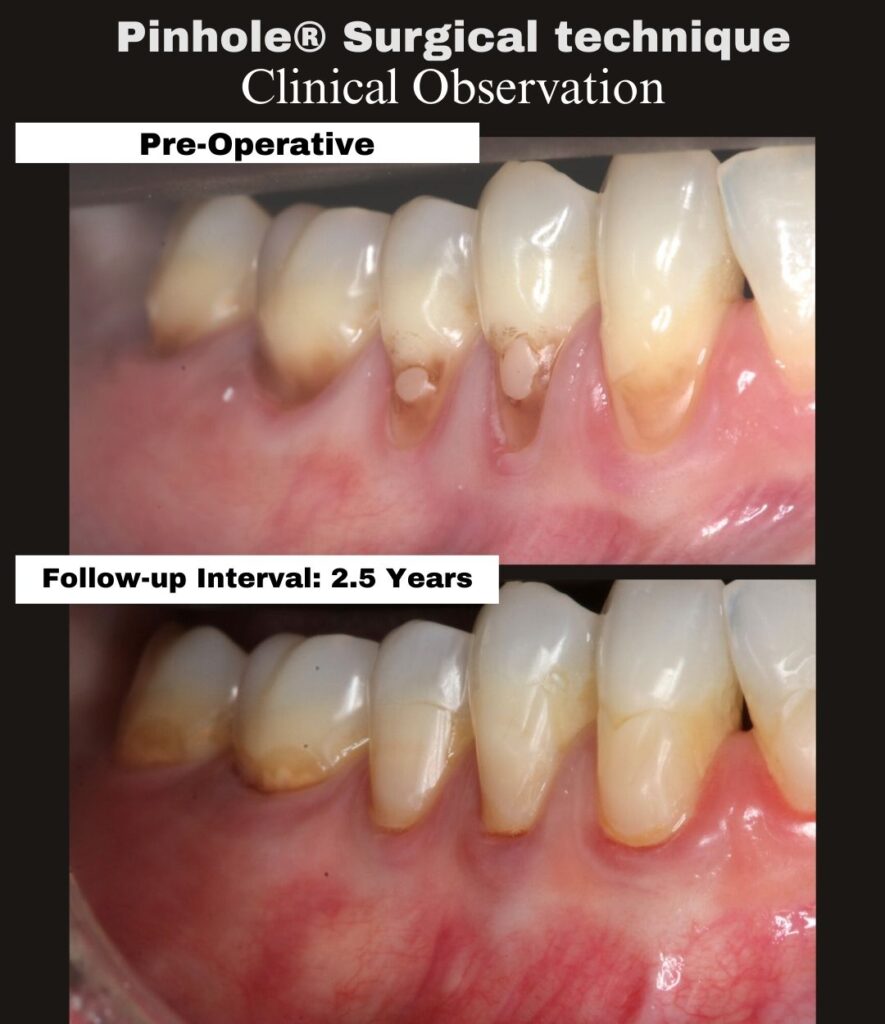
This case documents the 2.5-year post-operative outcome following treatment of generalized mandibular gingival recession using the Pinhole® Surgical Technique.

As documented in the original operative record from May 2023, the primary clinical objective was to achieve adequate soft-tissue release and controlled overcorrection to increase tissue thickness and establish a biologic environment supportive of long-term stability. The gingival margin position at surgery was intentionally not considered the final outcome.

At the 2.5-year post-operative interval, the treated sites demonstrate:

• Sustained coronal gingival margin position
• Stable soft-tissue thickness with maintained volume
• Preserved papillary architecture without scarring
• Long-term tissue adaptation consistent with biologic remodeling

At this interval, tissues have completed maturation and remodeling. The observed gingival margin position and contour reflect the patient’s biologic response over time rather than intraoperative placement. Stability at 2.5 years supports the principle that controlled overcorrection and adequate tissue release allow the gingiva to settle into a durable, biologically determined position.

The clinical significance of this case lies in the demonstration of long-term stability achieved without incisions or sutures, reinforcing the biologic basis of the Pinhole® Surgical Technique.

The Pinhole® Surgical Technique was developed by Dr. John Chao as a biologically guided, minimally invasive approach to the management of gingival recession.

For additional information:
www.pinholesurgicaltechnique.com

#PinholeSurgicalTechnique #ClinicalObservation #GingivalRecession #LongTermFollowUp #BiologyDrivenHealing #MinimallyInvasivePeriodontics #DrJohnChao
Pinhole News

Clinical Observation — Gingival Recession

Case Identification
Procedure: Pinhole® Surgical Technique
Tooth/Teeth: #18–22, #24–31
Procedure date: 05/23
Post-operative interval: 2.5 Years
Post-operative date: 01/26

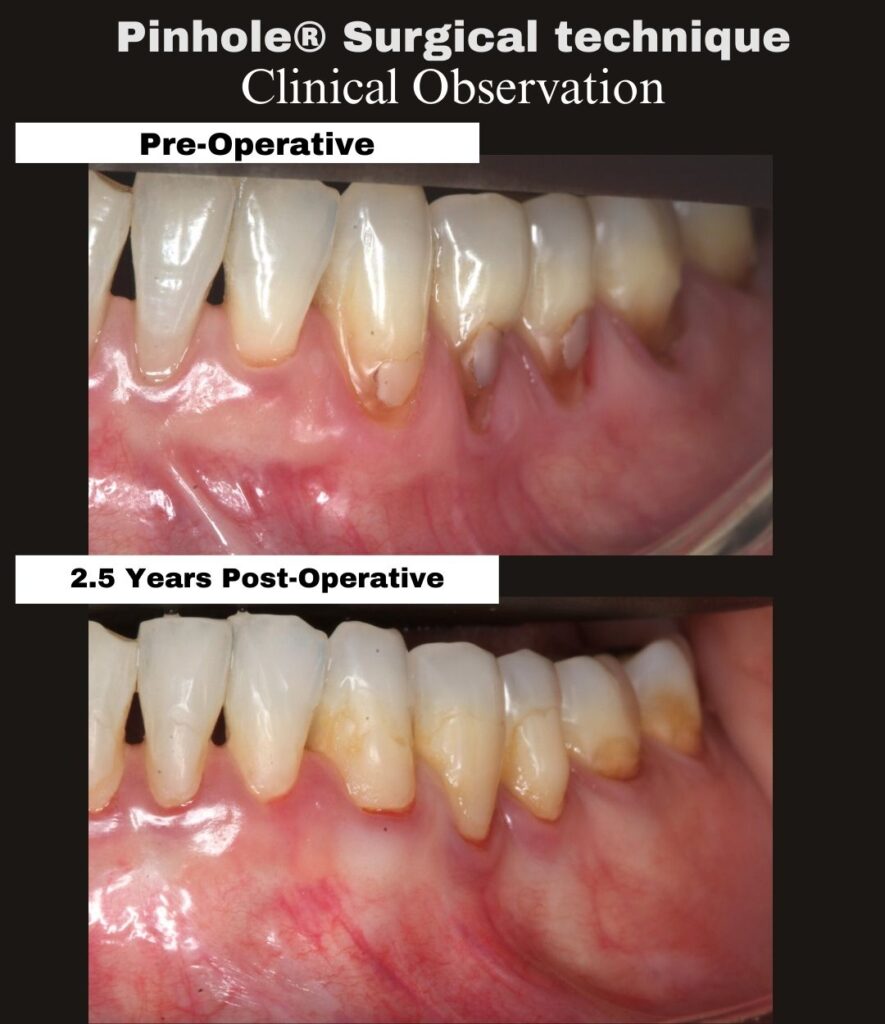
This case documents the 2.5-year post-operative outcome following treatment of generalized mandibular gingival recession using the Pinhole® Surgical Technique.

As documented in the original operative record from May 2023, the primary clinical objective was to achieve adequate soft-tissue release and controlled overcorrection to increase tissue thickness and establish a biologic environment supportive of long-term stability. The gingival margin position at surgery was intentionally not considered the final outcome.

At the 2.5-year post-operative interval, the treated sites demonstrate:

• Sustained coronal gingival margin position
• Stable soft-tissue thickness with maintained volume
• Preserved papillary architecture without scarring
• Long-term tissue adaptation consistent with biologic remodeling

At this interval, tissues have completed maturation and remodeling. The observed gingival margin position and contour reflect the patient’s biologic response over time rather than intraoperative placement. Stability at 2.5 years supports the principle that controlled overcorrection and adequate tissue release allow the gingiva to settle into a durable, biologically determined position.

The clinical significance of this case lies in the demonstration of long-term stability achieved without incisions or sutures, reinforcing the biologic basis of the Pinhole® Surgical Technique.

The Pinhole® Surgical Technique was developed by Dr. John Chao as a biologically guided, minimally invasive approach to the management of gingival recession.

For additional information:
www.pinholesurgicaltechnique.com

#PinholeSurgicalTechnique #ClinicalObservation #GingivalRecession #LongTermFollowUp #BiologyDrivenHealing #MinimallyInvasivePeriodontics #DrJohnChao
Pinhole News

Clinical Observation — Gingival Recession

Case Identification
Procedure: Pinhole® Surgical Technique
Tooth/Teeth: #19–25, #27–30
Procedure date: 12/30/25
Post-operative interval: 3 Weeks
Post-operative date: 01/22/26

Procedure time:
5:48 PM – 6:54 PM (66 minutes)


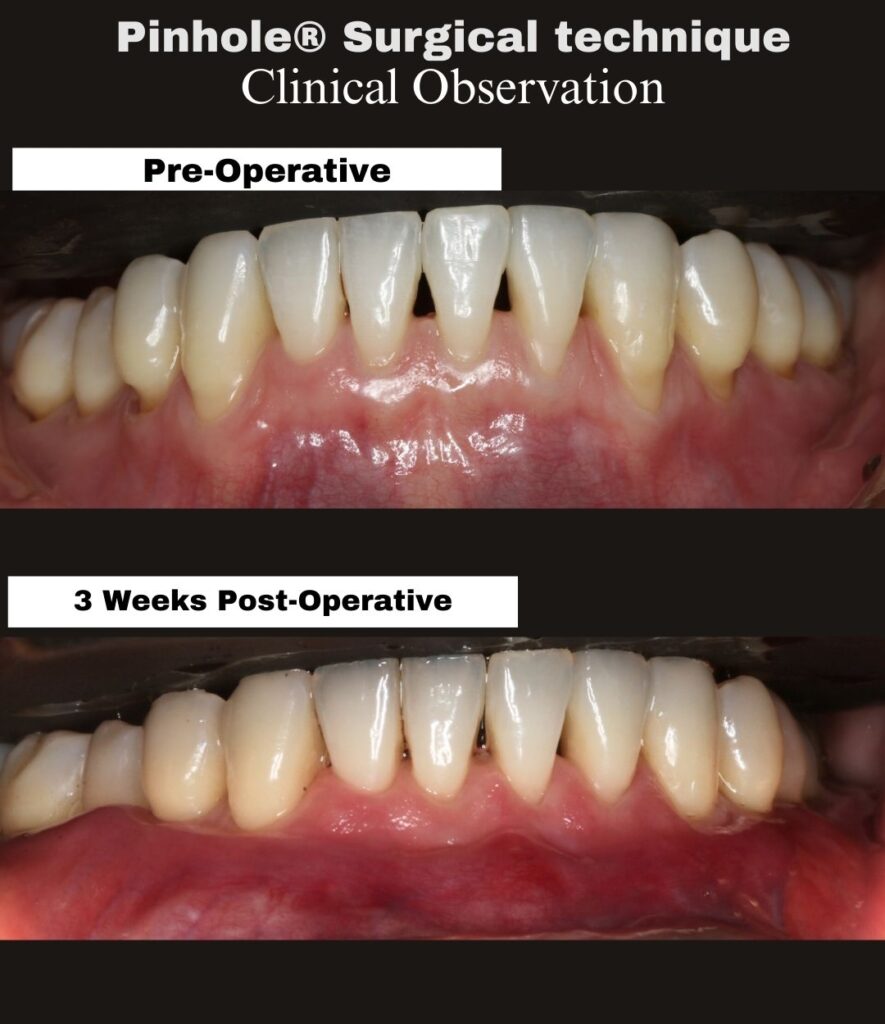
This case documents the immediate post-operative presentation following treatment of mandibular gingival recession using the Pinhole® Surgical Technique.

As documented in the operative record from December 30, 2025, the primary clinical objective was to achieve adequate soft-tissue release and controlled overcorrection to increase tissue thickness and establish a biologic environment supportive of long-term stability. The gingival margin position observed at this immediate interval is not intended to represent the final outcome.

At the immediate post-operative stage, the treated sites demonstrate:

• Successful coronal advancement of existing gingival tissues
• Increased soft-tissue volume consistent with controlled overcorrection
• Intact papillary architecture without incisions or sutures
• Early tissue adaptation and stability

At this interval, tissues remain within the acute inflammatory phase of healing. Gingival margin position, tissue contour, and marginal thickness are expected to evolve as edema resolves and biologic remodeling progresses. Final tissue position will be determined by the patient’s host tissue response, rather than intraoperative placement alone.

The clinical focus at this stage is protection of the surgical site and preservation of a stable biologic environment to allow uninterrupted vascularization and early wound healing.

The Pinhole® Surgical Technique was developed by Dr. John Chao as a biologically guided, minimally invasive approach to the management of gingival recession.

For additional information:
www.pinholesurgicaltechnique.com

#PinholeSurgicalTechnique #ClinicalObservation #GingivalRecession #ImmediatePostOp #BiologyDrivenHealing #MinimallyInvasivePeriodontics #DrJohnChao
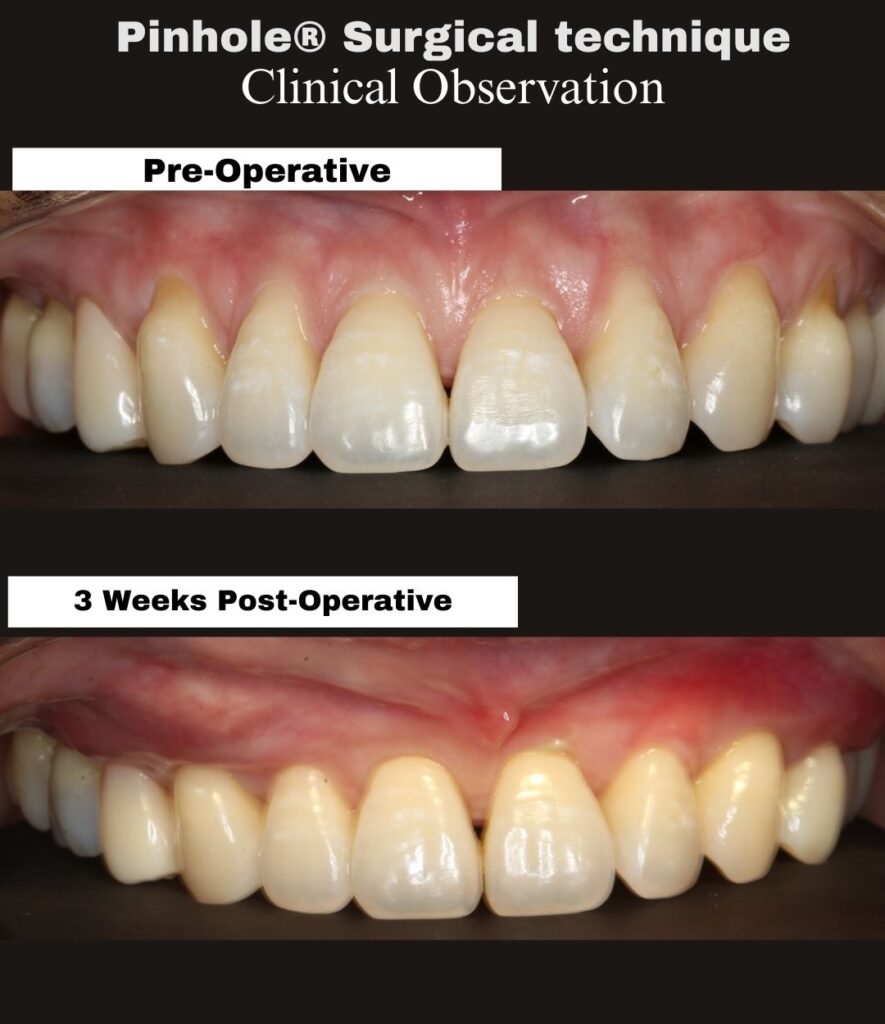
Pinhole News

Clinical Observation — Gingival Recession

Case Identification
Procedure: Pinhole® Surgical Technique
Tooth/Teeth: #3, #4, #6–12
Procedure date: 12/30/25
Post-operative interval: 3 Weeks
Post-operative date: 01/22/26

Procedure time:
3:35 PM – 5:15 PM (100 minutes)


This case documents the 3-week post-operative healing phase following treatment of maxillary gingival recession using the Pinhole® Surgical Technique.

As documented in the operative record from December 30, 2025, the primary clinical objective was to achieve adequate soft-tissue release and controlled overcorrection to increase tissue thickness and establish a biologic environment supportive of long-term stability. The immediate gingival margin position at surgery was not intended to represent the final outcome.

At 3 weeks post-procedure, the treated sites demonstrate:

• Progressive tissue maturation
• Increased gingival thickness consistent with controlled overcorrection
• Reduction in erythema and post-operative inflammation
• Continued marginal adaptation without incisions or sutures

At this interval, healing has transitioned from the inflammatory phase into early proliferative and remodeling phases. Gingival margin position may continue to evolve as biologic remodeling progresses and tissue stability increases. Final margin position is determined by the patient’s host tissue response, rather than intraoperative placement alone.

The clinical focus at this stage is maintenance of a stable biologic environment to support uninterrupted healing, collagen reorganization, and long-term marginal stability.

The Pinhole® Surgical Technique was developed by Dr. John Chao as a biologically guided, minimally invasive approach to the management of gingival recession.

For additional information:
www.pinholesurgicaltechnique.com

#PinholeSurgicalTechnique #ClinicalObservation #GingivalRecession #ThreeWeekHealing #BiologyDrivenHealing #MinimallyInvasivePeriodontics #DrJohnChao
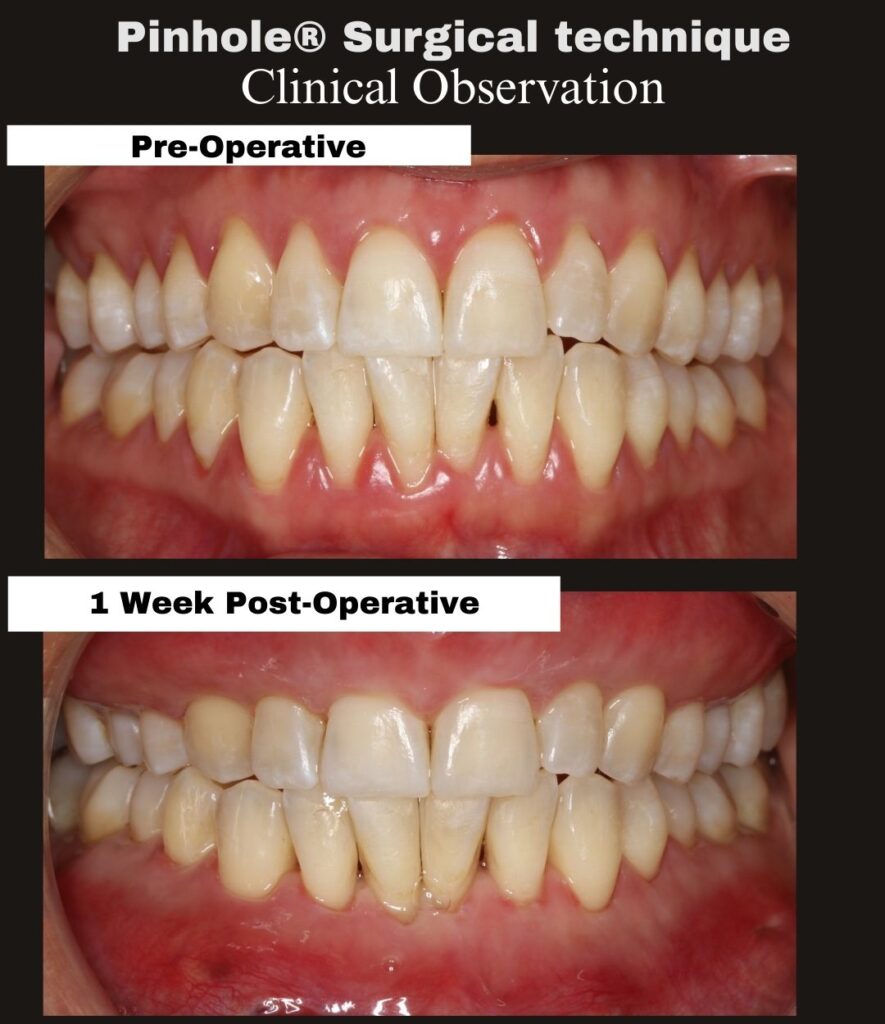
Pinhole News

Clinical Observation — Gingival Recession

Case Identification

Procedure: Pinhole® Surgical Technique
Tooth/Teeth: #3, #5–7, #9–14, #20–28
Procedure date: 01/09/26
Post-operative interval: 1 Week
Post-operative date: 01/20/26

Procedure time:

  • Upper: 11:23 AM – 12:30 PM (67 minutes)
  • Lower: 01:50 PM – 03:00 PM (70 minutes)

This case documents the 1-week post-operative healing phase following treatment of generalized gingival recession using the Pinhole® Surgical Technique.

As noted in the operative record from January 9, 2026, the primary clinical objective was to achieve adequate soft-tissue release and controlled overcorrection in order to increase tissue thickness and establish a biologic environment supportive of long-term stability. Immediate gingival margin position at the time of surgery was not intended to represent the final outcome.

At 1 week post-procedure, the treated sites demonstrate:

  • Early tissue stabilization
  • Increased soft-tissue volume consistent with controlled overcorrection
  • Reduction in post-operative inflammation
  • Absence of incisions or sutures

At this interval, healing remains within the inflammatory and early proliferative phases. Gingival margin position may continue to change as inflammation resolves and biologic remodeling progresses. Final tissue position is determined by the patient’s host tissue response rather than intraoperative placement alone.

The clinical focus at this stage is preservation of a stable environment to allow uninterrupted biologic healing and tissue maturation.

The Pinhole® Surgical Technique was developed by Dr. John Chao as a biologically guided, minimally invasive approach to the management of gingival recession.

For additional information:
www.pinholesurgicaltechnique.com

#PinholeSurgicalTechnique #ClinicalObservation #GingivalRecession #EarlyHealing #BiologyDrivenHealing #MinimallyInvasivePeriodontics #DrJohnChao
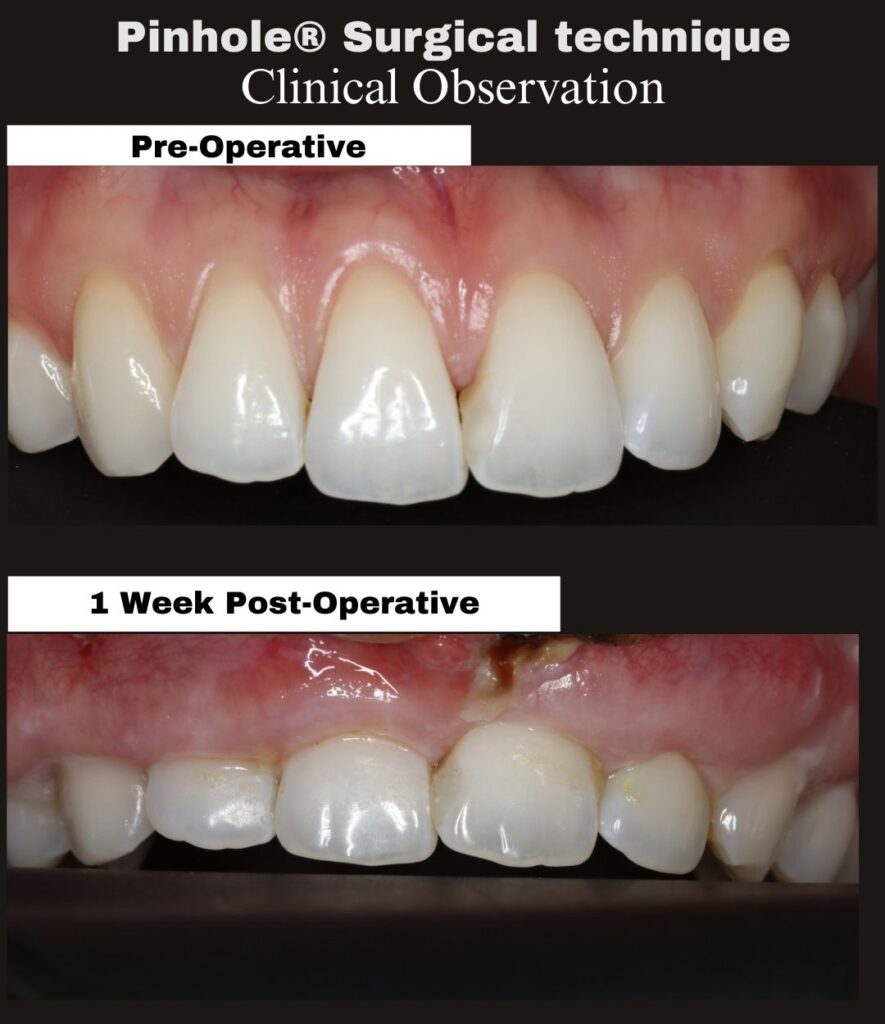
Pinhole News

Clinical Observation — Gingival Recession

Case Identification

Procedure: Pinhole® Surgical Technique
Tooth/Teeth: #6–11
Procedure date: 01/13/26
Post-operative interval: 1 Week
Post-operative date: 01/20/26

This case documents the 1-week post-operative healing phase following treatment of maxillary gingival recession using the Pinhole® Surgical Technique.

As noted in the operative record from January 13, 2026, the primary clinical objective was to achieve adequate soft-tissue release and controlled overcorrection in order to increase tissue thickness and establish a biologic environment supportive of long-term stability. Immediate gingival margin position at the time of surgery was not intended to represent the final outcome.

At 1 week post-procedure, the treated sites demonstrate:

  • Early tissue stabilization
  • Increased soft-tissue volume consistent with controlled overcorrection
  • Reduction in post-operative inflammation
  • Absence of incisions or sutures

At this interval, healing remains within the inflammatory and early proliferative phases. Gingival margin position may continue to change as inflammation resolves and biologic remodeling progresses. Final tissue position is determined by the patient’s host tissue response rather than intraoperative placement alone.

The clinical focus at this stage is preservation of a stable environment to allow uninterrupted biologic healing and tissue maturation.

The Pinhole® Surgical Technique was developed by Dr. John Chao as a biologically guided, minimally invasive approach to the management of gingival recession.

For additional information:
www.pinholesurgicaltechnique.com

#PinholeSurgicalTechnique #ClinicalObservation #GingivalRecession #EarlyHealing #BiologyDrivenHealing #MinimallyInvasivePeriodontics #DrJohnChao
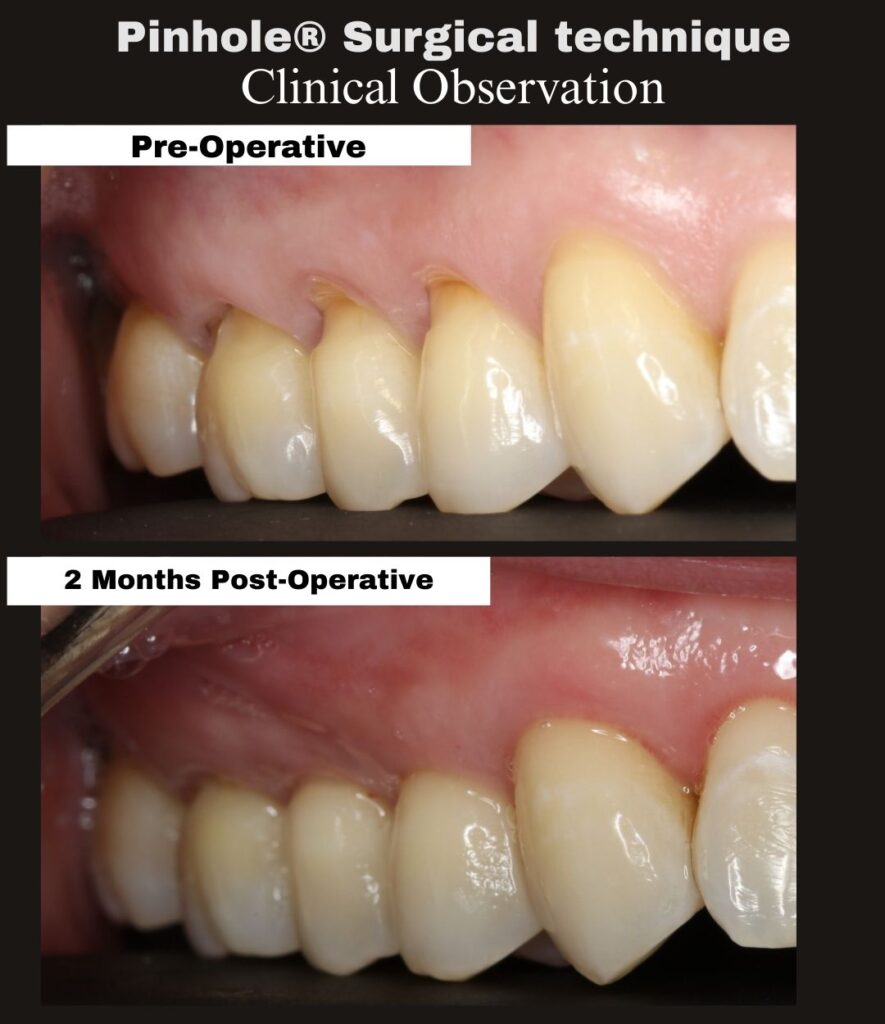
Pinhole News

Clinical Observation — Gingival Recession

Case Identification

Procedure: Pinhole® Surgical Technique
Tooth/Teeth: #2–7, #10–15
Procedure date: 11/10/25
Post-operative interval: 2 Months
Post-operative date: 01/20/26
Procedure time: 10:58 AM – 12:10 PM (72 minutes)

This case documents the 2-month post-operative healing phase following treatment of maxillary gingival recession using the Pinhole® Surgical Technique.

As noted in the operative record from November 10, 2025, the primary clinical objective was to achieve adequate soft-tissue release and controlled overcorrection in order to increase tissue thickness and establish a biologic environment supportive of long-term stability. Immediate gingival margin position at the time of surgery was not intended to represent the final outcome.

At 2 months post-procedure, the treated sites demonstrate:

  • Stable gingival margin position across the treated segments
  • Improved soft-tissue thickness and contour
  • Healthy tissue color and texture consistent with ongoing maturation
  • Absence of incisions or sutures

At this interval, healing has progressed beyond the inflammatory phase and continues through active biologic remodeling. Gingival margin position may continue to refine as tissue maturation progresses. Final tissue position is determined by the patient’s host tissue response rather than intraoperative placement alone.

The clinical focus at this stage is confirmation of tissue stability while allowing uninterrupted biologic adaptation to continue.

The Pinhole® Surgical Technique was developed by Dr. John Chao as a biologically guided, minimally invasive approach to the management of gingival recession.

For additional information:
www.pinholesurgicaltechnique.com

#PinholeSurgicalTechnique #ClinicalObservation #GingivalRecession #BiologyDrivenHealing #ControlledOvercorrection #MinimallyInvasivePeriodontics #DrJohnChao
Pinhole News

Clinical Observation — Gingival Recession

Case Identification

Procedure: Pinhole® Surgical Technique
Tooth/Teeth: #5, 6, 12, 13, 19–30
Procedure date: 10/24/25
Post-operative interval: 3 Months
Post-operative examination date: 01/19/26
Procedure time: 2:28 PM – 3:15 PM (47 minutes)

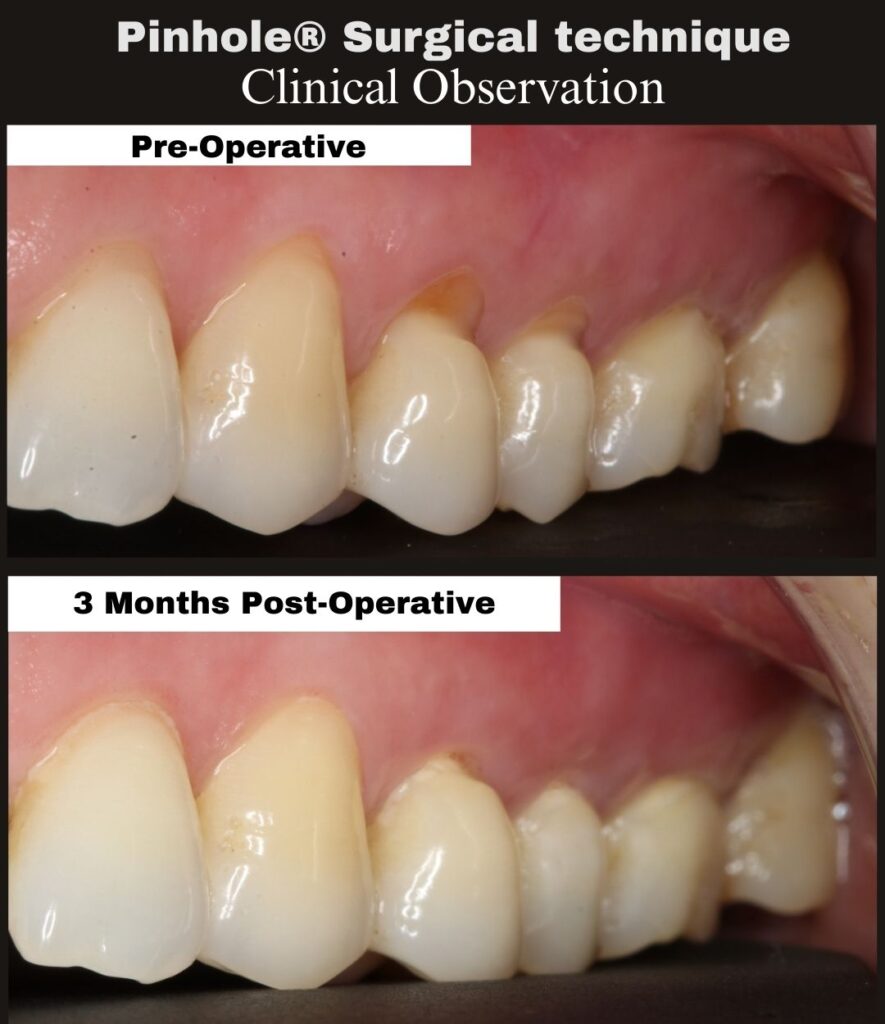
This case documents early long-term tissue stabilization following treatment of generalized gingival recession using the Pinhole® Surgical Technique.

As recorded at the time of surgery, the primary clinical objective was to achieve adequate soft-tissue release and controlled coronal repositioning to increase tissue thickness and establish a biologic environment supportive of long-term stability. Immediate gingival margin position at the time of surgery was not intended to represent the final outcome.

At 3 months post-procedure, the treated sites demonstrate:

• Stable gingival margin position across maxillary and mandibular arches
• Maintained soft-tissue thickness and contour
• Absence of recurrent gingival recession
• Healthy tissue color and texture consistent with ongoing maturation

At this interval, healing is progressing through the biologic remodeling phase. Continued tissue adaptation is expected as inflammation resolves and maturation advances. Final gingival margin position is determined by host tissue response over time, not by intraoperative placement alone.

Pinhole News

Clinical Observation — Gingival Recession

Case Identification

Procedure: Pinhole® Surgical Technique
Tooth/Teeth: #8–10
Procedure date: 08/2012
Follow-up interval: 12.5 Years
Follow-up examination date: 01/2026

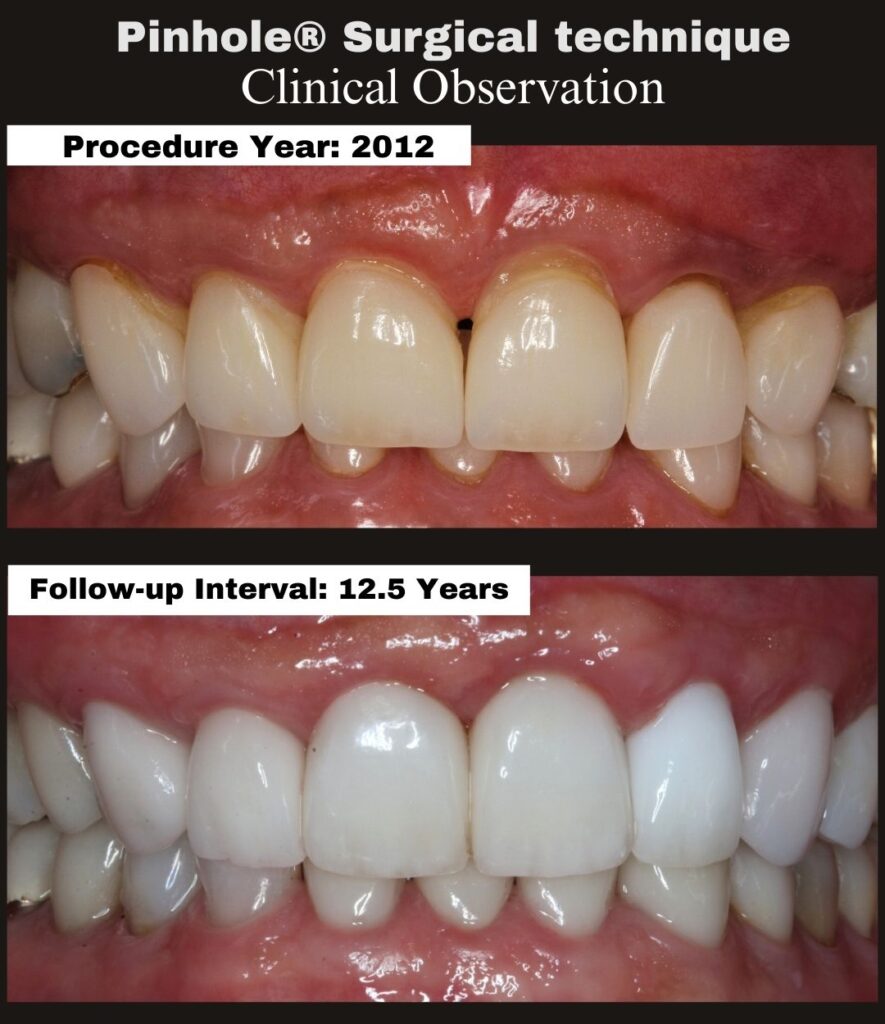
This case documents long-term clinical stability following treatment of maxillary anterior gingival recession using the Pinhole® Surgical Technique.

As recorded at the time of surgery, the primary clinical objective was to achieve adequate soft-tissue release and controlled overcorrection in order to increase tissue thickness and establish a biologic environment supportive of long-term stability. Immediate gingival margin position at the time of surgery was not intended to represent the final outcome.

At 12.5 years post-procedure, the treated sites demonstrate:

• Stable gingival margin position at #8–10
• Preservation of soft-tissue thickness and contour
• Absence of recurrent gingival recession
• Stable interdental papilla architecture
• Tissue color and texture consistent with mature, healthy gingiva

At this interval, healing and tissue maturation are considered complete. The observed stability reflects long-term host tissue adaptation following establishment of a favorable biologic environment at the time of treatment. Final gingival margin position is determined by the patient’s host tissue response rather than intraoperative placement alone.

The clinical focus of this long-term follow-up is assessment of durability, tissue stability, and maintenance of gingival health in the esthetic zone over time.

The Pinhole® Surgical Technique was developed by Dr. John Chao as a biologically guided, minimally invasive approach to the management of gingival recession.

For additional information:
www.pinholesurgicaltechnique.com

#PinholeSurgicalTechnique #ClinicalObservation #GingivalRecession #LongTermStability #EstheticZone #BiologyDrivenHealing #MinimallyInvasivePeriodontics #DrJohnChao
Pinhole News

Clinical Observation — Gingival Recession

Case Identification

Procedure: Pinhole® Surgical Technique with Papilla Regeneration
Tooth/Teeth: #8–9
Procedure date: 09/02/25
Post-operative interval: 4 Months
Procedure time: 10:51 AM – 12:26 PM (95 minutes)

This case documents mid-term post-operative healing following treatment of maxillary anterior gingival recession with associated interdental papilla deficiency using the Pinhole® Surgical Technique.

As recorded at the time of surgery, the primary clinical objective was to achieve adequate soft-tissue release and controlled overcorrection to increase tissue thickness and create a biologic environment supportive of papilla regeneration and long-term stability. Immediate post-surgical tissue position was not intended to represent the final esthetic outcome.

At 4 months post-procedure, the treated sites demonstrate:

• Re-established interdental papilla between #8 and #9
• Increased soft-tissue thickness and volume in the anterior maxilla
• Stable gingival margins with harmonious tissue contours
• Resolution of post-operative inflammation
• Intact tissue continuity without evidence of incisions or sutures

At this interval, soft-tissue maturation and biologic remodeling are well underway. Gingival margin position and papillary architecture reflect host tissue response over time rather than intraoperative positioning alone, consistent with biologically guided healing.

The clinical focus of this evaluation is assessment of tissue stability, papilla regeneration, and integration of soft tissue within the esthetic zone.

The Pinhole® Surgical Technique is a biologically guided, minimally invasive approach developed by Dr. John Chao for the management of gingival recession and associated soft-tissue deficiencies without scalpels or sutures.

For additional information:
www.pinholesurgicaltechnique.com

#PinholeSurgicalTechnique #ClinicalObservation #PapillaRegeneration #EstheticZone #GingivalRecession #BiologyDrivenHealing #MinimallyInvasivePeriodontics

Posts pagination