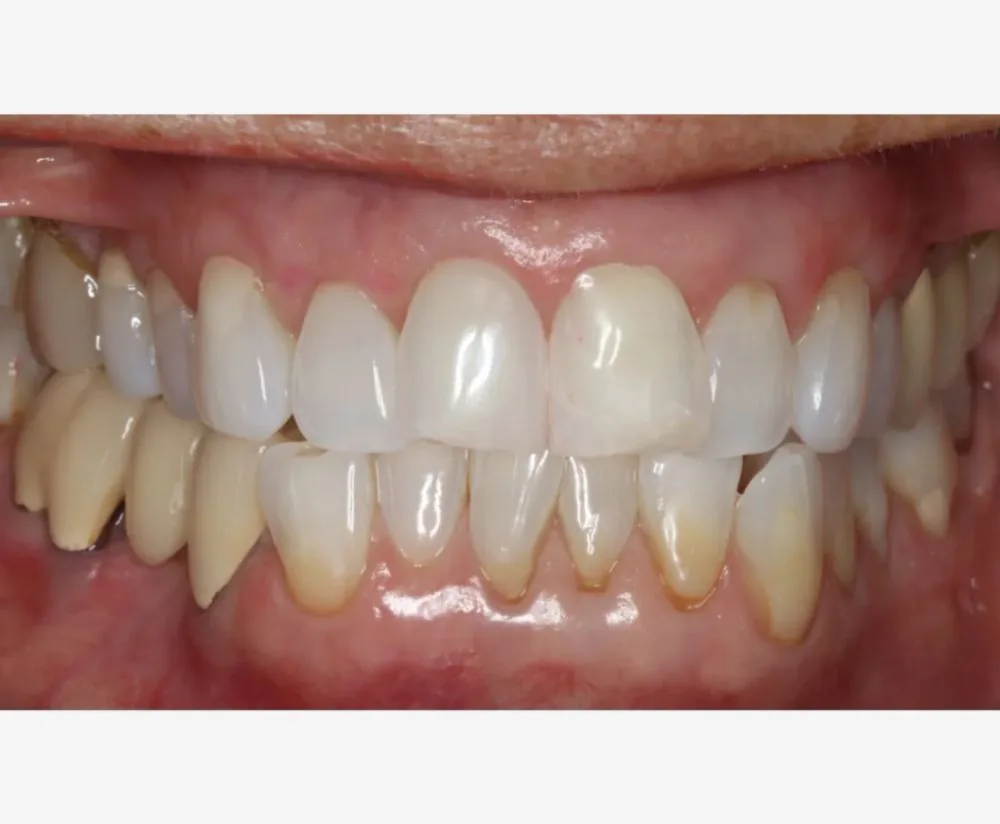
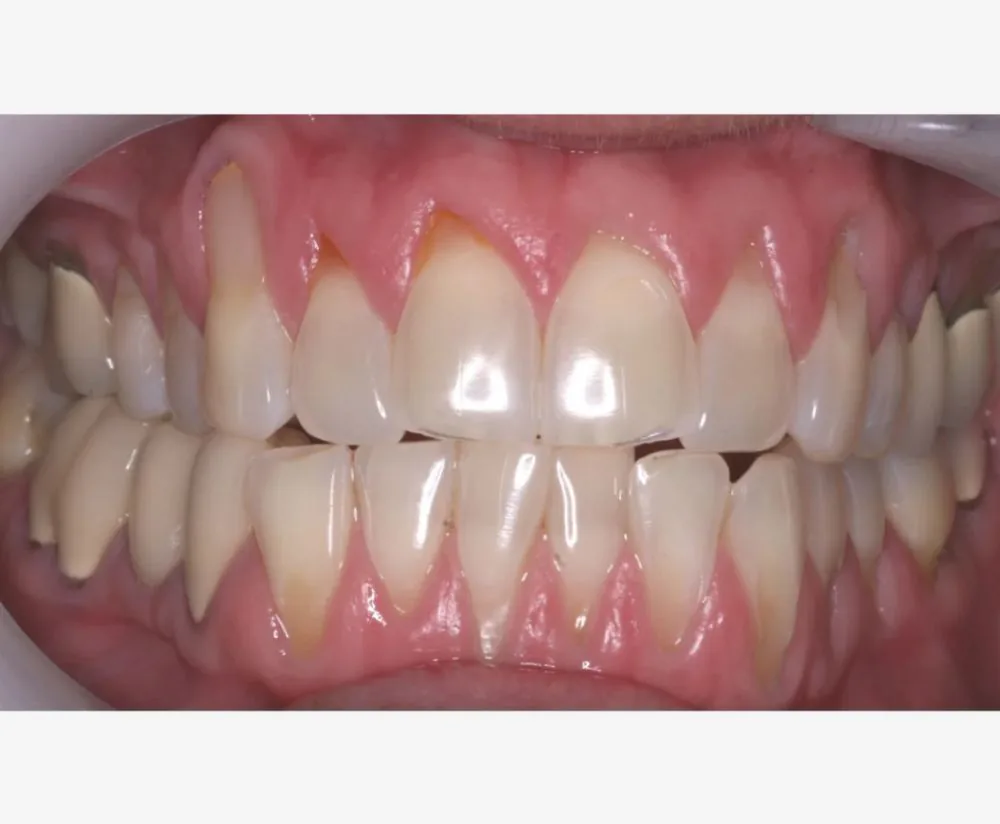
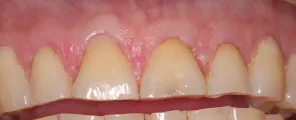
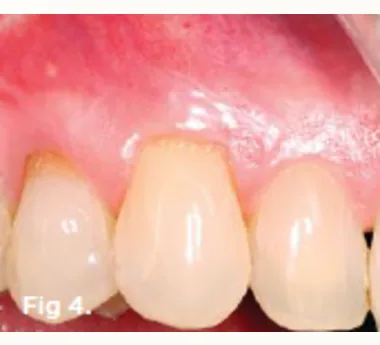
Real patient · root coverage maintained at 15-year follow-up. Drag the divider to compare.
24–48h
back to normal activity
~22 min
mean procedure time
Peer-reviewed & published in
Int. J. Periodontics & Restorative DentistryCompendiumJ. Cosmetic Dentistry
/ HOW PINHOLE® WORKS
Tissue is loosened and guided — not cut and stitched.
A single 2–3 mm entry is made with a needle. Using specially designed instruments, the gum is loosened and guided over the receded part of the tooth. With no releasing incision and no suturing, patients typically experience minimal pain, swelling, and bleeding — with immediate cosmetic results.
1Needle entry. A single 2–3 mm opening is made above the recession site.
2Guided coverage. Tissue is loosened and gently repositioned over the exposed root.
3Collagen stabilizes. Bioresorbable strips hold the new gumline — no graft donor site.
Long-term stability depends on addressing the cause of recession — biotype, brushing, occlusion — alongside the collagen membrane supporting new tissue attachment over time.
Equivalent outcomes, fewer practices offering it. A randomized trial found no significant difference in recession reduction versus grafting — and few practices offer PST, so it answers patients who have declined a graft. See both studies →
/ WHY CLINICIANS ADOPT IT
What PST lets you offer that grafting can’t.
Side by side with the connective-tissue graft.
1 visit
A full arch — upper and lower — treated in a single session
0 donor sites
Tissue is guided over the root, never harvested from the palate
0 sutures
A 2–3 mm entry closes on its own — no removal visit
Pinhole®
versus
Connective tissue graft
Sites per visit
Full arch, one visit
Staged by quadrant
Donor site
None
Palatal harvest
Access
2–3 mm pinhole
Scalpel incision
Closure
No sutures
Sutures + removal visit
Cosmetic result
Visible same day
After healing
/ TREATMENT PLANNING
Planning for a predictable result.
PST is predictable when it’s matched to the right patient and the right goal. Recognizing that match is a skill — and it’s the first thing training teaches.
✓
Where PST performs best
Recession with healthy interdental tissueMultiple adjacent sites — treatable in a single visitPatients who want a scalpel-free, suture-free option
◉
Where judgment matters
Treating active periodontal disease before planning PSTAdvanced recession, where the realistic goal shifts from full coverage to thicker, healthier tissueReading tissue phenotype and healing factors before you commit
The full case-selection framework is taught, not published.
Classification, phenotype thresholds, and how to set the goal case by case — Dr. Chao walks through the decision criteria in the free intro webinar.
Based on 28 of the original patients recalled at a mean of 14.5 years (68 Class I and II sites). Outcomes depend on case selection and technique — which is why training emphasizes both.
Chao J, et al. Long-Term Retrospective Case Series of the Pinhole Surgical Technique. Int J Periodontics Restorative Dent 2026;46:299–305.
Documented case · PST · 33 months and 18 years post-op
Baseline
Before treatment
After PST
33 months post-op
Long-term recall
18 years post-op
Clinical photographs reproduced from Chao J, et al. Int J Periodontics Restorative Dent 2026;46:299–305.
Study 2 of 2 · Randomized head-to-head (Compendium)
Same results as the gold standard — without the second surgery.
36 patientsBoth techniques in the same mouth1-year follow-upRandomized split-mouth
One side treated with PST
Pinhole + collagen membrane
✓ One surgical site
✓ No palatal wound
✓ No sutures
Other side, the gold standard
CAF + connective tissue graft
✕ Second surgical site
✕ Donor tissue harvested from the palate
✕ Sutured closure
Recession reduction
Equivalent · P = .53
PST + collagen membrane1.97 mm
CAF + connective tissue graft1.98 mm
Mean root coverage
Equivalent · P = .72
PST + collagen membrane63.6%
CAF + connective tissue graft65.4%
Verdict: no significant difference in efficacy — and both gained attachment (P = .9).
Method: split-mouth randomized trial — coronally advanced flap with connective tissue graft (CAF + CTG) on one side, Pinhole® Surgical Technique with a collagen matrix (PST + CM) on the contralateral side; both assessed at 1 year.
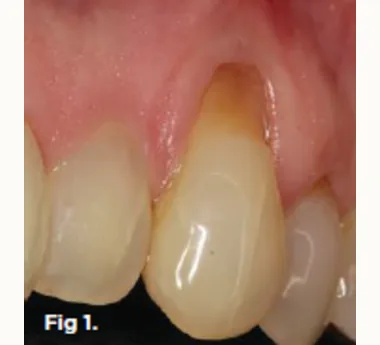
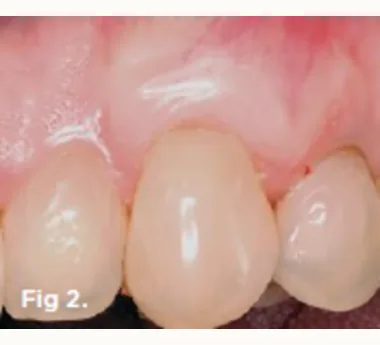
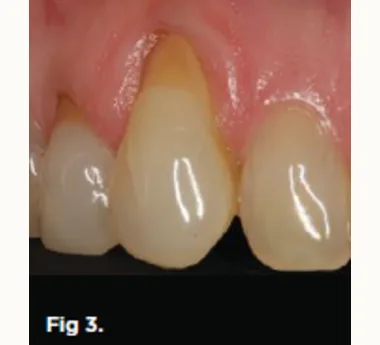
Representative cases, figure numbering as published. Reproduced from Shibly O, Chao JC, et al. Compendium 2025;46(1).
One measure favored the graft: keratinized tissue width increased significantly in the CTG group over the year (2.38 → 2.61 mm, P = .002). Patient-reported outcomes showed no significant difference.
Shibly O, Chao JC, Albandar JM, Almehmadi N, Al-Sabbagh M. Compendium 2025;46(1) — split-mouth randomized clinical trial.
Think PST could fit your practice? Start with the free webinar.
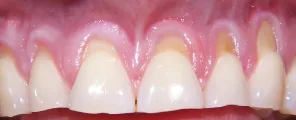
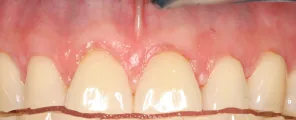
Multiple recession sites, corrected in a single visit.
Documented long-term cases — root coverage photographed years after a single-visit treatment.
Results vary by case selection and biotype. Class III cases target thicker, wider tissue rather than complete root coverage.
BEFORE
AFTER
6-Year Case
BEFORE
AFTER
3-Year Case
BEFORE
AFTER
14-Year Case
BEFORE
AFTER
10-Year Case
/ BUILT FOR CONFIDENCE
The goal isn’t just certification. It’s doing your first cases with confidence.
Most dentists don’t hesitate because they doubt the technique — they hesitate about their own first cases. Training is built to close that gap before you ever treat a patient.
01
Hands-on before patients
Practice on a typodont and mount until the instrument movements feel natural — so your first real case isn’t your first attempt.
02
A clear case-selection framework
Learn which patients are strong candidates and which aren’t, so you start with cases set up to succeed.
03
Direct mentorship with Dr. Chao
One-on-one guidance from the technique’s originator — bring your own cases and get specific answers.
04
Support after you’re certified
Graduate troubleshooting, refresher days, and a community of certified clinicians for the cases where you want a second opinion.
The honest part
PST is technique-sensitive — flap handling takes practice, and perforation or partial coverage are real early-case risks. Training covers how to avoid them and how to manage a case that doesn’t fully cover, so your first cases are supported, not solo.
You shouldn’t have to learn PST alone. Training is designed so you build judgment and skill before the stakes are real.
/ IF IT’S A FIT
If PST makes sense for your practice, here’s how training works.
Once you’ve decided PST is right for you, training takes you from understanding to confident first cases. Choose the path that fits your goals.
Training is a practice investment. Here’s the range — payment options are available.
New to PST® · Online
Online Course
$5,500· 7 CE
✓ 24-month HD video access (EN/ES)✓ 13-piece patented instrument kit ($4,000 value)✓ Typodont & practice mount✓ Unlimited 1-on-1 mentorship with Dr. Chao✓ Private community of certified clinicians
Two questions come up more than any other: how the online course actually runs, and what an in-person day looks like hour by hour. Here’s both.
The online course
18 modules · 7 hours · 7 CE · at your own pace
1
Enroll
Choose your path and pay securely online. Payment options are available — just ask.
2
Sign the agreement
We email an e-agreement right after payment. Signing it releases your course access and kit.
3
Course access & kit arrive
Your course link is emailed and your kit ships — 13-piece patented instrument cassette, typodont, and practice mount.
4
Work through 18 modules
Seven hours of HD video in English or Spanish, on your schedule, with 24-month access. Practice on the typodont as you go.
5
Pass the final exam
Roughly 40 questions, 85% to pass — covering technique, case selection, and protocol.
6
Certified — plus ongoing support
Your certificate and 7 CE credits are issued. Request a 1-on-1 with Dr. Chao any time by phone or email — unlimited, including a walkthrough of your first real case.
The in-person days
Alhambra Chamber of Commerce, Alhambra, CA · 7 CE per day
Each in-person day runs 7:00 AM to 5:00 PM and carries 7 CE. Full details are provided after registration.
Day 1 · Foundational
Friday — core skills & technique
7:00 AM – 5:00 PM · 7 CE
What to expect on the day
✓
Lecture
Technique fundamentals, case selection, and treatment planning.
✓
Hands-on typodont training
Working the patented instruments under Dr. Chao’s guidance — the largest share of the day.
✓
Live surgery observation
Watch Dr. Chao treat real cases start to finish.
✓
Personalized technique feedback
Direct correction and coaching while you practice.
✓
Resources, certification, evaluation & CE
✓
Discussion & Q&A
Plus continental breakfast, lunch, and refreshments.
Day 2 · Advanced
Saturday — full arch & implants
7:00 AM – 5:00 PM · 7 CE
What to expect on the day
✓
Post-op review of Day 1 cases
See how the previous day’s surgical cases healed.
✓
Advanced session
Literature review, complications management, technique review, and case presentations.
✓
Full-arch typodont training
Hands-on across both upper and lower arches.
✓
Two full-arch live surgeries
Observe a full upper arch and a full lower arch case, each start to finish.
✓
Advanced protocols
Implants with PST®, targeted drug delivery, brushing stent, and DNA bacteriological testing.
✓
Resources, certification, evaluation & CE
✓
Discussion & Q&A
Plus continental breakfast, lunch, and refreshments.
Venue
Alhambra Chamber of Commerce
104 S. First Street, Alhambra, CA 91801 — about 8 miles east of downtown Los Angeles. Street and nearby lot parking; the guide sent after registration names the closest lot.
Getting there
Fly into LAX, BUR, or ONT
Burbank (BUR) is usually the shortest drive, roughly 25–35 minutes; LAX and Ontario (ONT) both run about 45–60 minutes depending on traffic. A car or rideshare is the practical way in.
Where to stay
Alhambra or Pasadena
Hotels in Alhambra and Pasadena sit within a 10–20 minute drive of the venue. The post-registration guide includes a recommended list — ask the office whether a room block is open for your date.
On the day
7:00 AM start · meals provided
Doors open before the 7:00 AM start. Continental breakfast, lunch, and refreshments are included, along with all instruments and equipment. Bring your own surgical loupes.
Compare the three paths
CE credits are earned per component — 7 from the online course, 7 for each in-person day.
Online Course
$5,500
+ Foundational Day
$7,500 · most popular
+ Advanced Day
$9,500
18 online modules (7 hrs)
✓
✓
✓
Instrument kit, typodont & mount
✓
✓
✓
Unlimited 1-on-1 mentorship
✓
✓
✓
Day 1 — hands-on + live surgery
—
✓
✓
Day 2 — full arch, implants & complications
—
—
✓
Total CE credits
7 CE
14 CE
21 CE
Pinhole® Certification
On passing the final exam
On passing the exam, or by attending the in-person day
On passing the exam, or by attending the in-person days
Attending an in-person day before finishing the online modules still certifies you — you earn the 7 CE for that day, and the online course’s 7 CE once you complete the modules and pass the exam.
Free · No obligation
Pinhole® Surgical Technique Fundamentals
Achieving Predictable, Long-Term Root Coverage
A minimally invasive option for gum recession — no scalpel, no donor site. Presented by Dr. John Chao.
Want to see more before anything else? Start here.
Two ways in: watch the free intro webinar now, or join the email list for case videos and study updates. No commitment either way.
1 · Free webinar
Achieving Predictable, Long-Term Root Coverage
The PST® Fundamentals webinar with Dr. John Chao — the technique, case selection, and implementation. Free, on your schedule.
Free · pick a session above and start watching immediately.
2 · Email updates
Pinhole® Insider
Tell us a little about your practice and we’ll follow up with course details, documented case videos, and study updates.
Pinhole® Surgical Technique
Advanced training and certification in the Chao Pinhole® Surgical Technique for dental professionals.
Chao Seminars
Nationally Approved PACE Program Provider for FAGD/MAGD credit.
Approval does not imply acceptance by
any regulatory authority or AGD endorsement.
8/1/2025 to 7/30/2029
Provider ID# 365454